
Heavy Tow Truck Fleet: Inside Delta Heavy Towing's Equipment
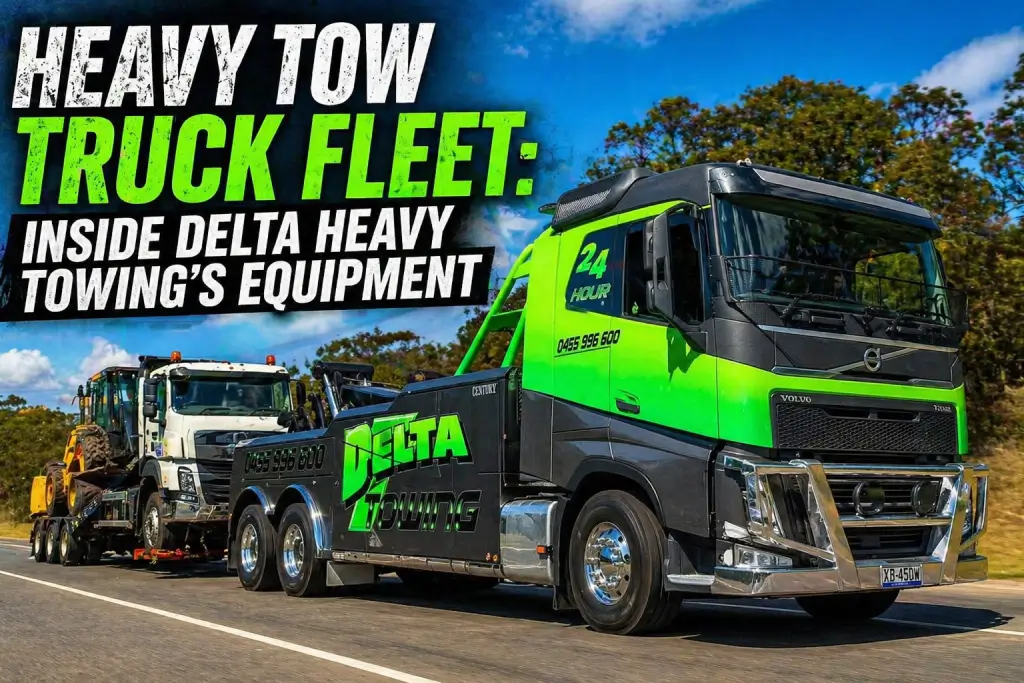
What tow trucks does Delta Heavy Towing run, and what is each one used for?
In short: Four types. Heavy boom trucks with underlifts handle on-road truck breakdowns, heavy tilt trays rated to 25 tonnes carry machinery, smaller trucks and buses, low loaders move tracked plant, and a rotator uprights rolled trucks and recovers vehicles from embankments. Every unit follows a documented maintenance schedule and carries GPS tracking.
A rotator is a tow truck with a hydraulic arm that can extend, lift and rotate a load, working like a small crane permanently mounted on a heavy truck chassis.
Best for:
- Fleet managers checking a company can handle their largest vehicle
- Construction companies needing the right trailer for an excavator
- Bus operators asking whether a boom truck can manage a 16-tonne coach
For example, if a truck has rolled onto its side in a ditch, the rotator could upright it and reposition it for towing without waiting for a mobile crane to arrive and set up.
Official references:
Inside Our Heavy Tow Truck Fleet
We get asked about our trucks regularly. Fleet managers want to know if we can handle their largest vehicle. Construction companies want to know if we have the right trailer for their excavator. Bus operators want to know if our boom truck can manage a 16-tonne coach. So here is a breakdown of what we run and what each unit does.
Heavy Boom Trucks
These are our primary towing units for on-road truck breakdowns. A boom truck has a hydraulically operated arm that extends from the rear of the tow truck, with an underlift that slides under the casualty vehicle's axle. The boom lifts one end of the truck off the ground, and the underlift secures it for towing. The rotator is the centrepiece of our rollover recovery capability.
Our boom trucks are rated to handle the weight of a loaded semi-trailer prime mover. They carry recovery gear including winches, chains, snatch blocks, and rated shackles. They also carry traffic management equipment: cones, signs, and flashing lights for motorway work.
Boom trucks are the right choice when the casualty vehicle has working rear wheels (or working front wheels, depending on which end is lifted). They are fast to connect and efficient on the road.
Heavy Tilt Trays
Our heavy tilt trays are rated to 25 tonnes, which is substantially higher than the 3-4 tonne tilt trays used for car towing. The tray tilts to ground level, the vehicle or machine is driven or winched onto it, and the tray returns to horizontal for transport. Our low loaders also handle oversized vehicle transport under permit.
We use tilt trays for machinery that cannot be towed on its own wheels, smaller trucks where loading is safer or faster than boom towing, buses where we want to protect the bus tyres and driveline during long-distance transport, and equipment with damaged steering or suspension that makes wheel-down towing unsafe.
Low Loaders
Low loaders are flatbed trailers with a low deck height, towed by a prime mover. The low deck makes loading tracked machinery easier and keeps the overall transport height within legal limits.
We use low loaders for excavators, bulldozers, rollers, loaders, and other tracked or wheeled plant that needs to ride flat. The ramps allow machines to drive on under their own power where site conditions permit, or be winched on using the trailer's integrated winch.
Rotator Recovery Unit
The rotator is the most specialised piece of equipment in our fleet. It has a hydraulically operated arm mounted on a heavy truck chassis that can extend, lift, and rotate a load. Think of it as a small crane permanently mounted on a tow truck. To work out which of these units your vehicle needs, see our tow truck sizing guide.
We use the rotator for rolling over capsized trucks (uprighting a vehicle on its side), extracting vehicles from embankments, ditches, and off-road positions, lifting vehicles over barriers where access from the normal direction is blocked, and complex recoveries that need the vehicle repositioned before it can be towed.
The rotator replaces the need for a mobile crane in many recovery situations, which saves hours on scene because we do not need to wait for a crane to arrive and set up.
Fleet Maintenance
Every vehicle in our fleet is maintained on a documented schedule. Pre-start inspections happen before every shift. Servicing follows manufacturer intervals. Our maintenance records are part of our TruckSafe accreditation and are audited.
All vehicles carry GPS tracking. The operations team can see where every truck is in real time, which helps with dispatching the closest available unit and providing accurate ETAs to customers. For planned work, ask our office which unit is free and when.
Does It Match Your Job?
If you are not sure whether our fleet can handle your towing or transport requirement, call us on 0455 996 600 and describe the job. Our dispatcher will tell you which truck is right and provide a quote.
Need this handled today?
Dispatch is staffed 24 hours a day, and we quote before the truck rolls. Tell us the vehicle, the location and where it needs to go.
Keep reading
Related guides
How to Choose a Towing Company in Brisbane: Local Expert Tips
Brisbane has dozens of towing companies. The Google results page is long, the ads are aggressive, and everyone claims to be the best. When your truck…
Read the article
What Makes a Good Heavy Duty Towing Company? 7 Things to Check
Plenty of towing company in Brisbane will tell you they handle heavy vehicles. Fewer actually have the equipment, licences, and experience to do it p…
Read the article
Heavy Duty Towing vs Standard Towing: What Is the Difference?
People who drive cars rarely think about towing categories. A tow truck is a tow truck. But if you operate trucks, buses, or heavy equipment, the dis…
Read the article