
What Size Tow Truck Do I Need? A Guide to Heavy Tow Trucks
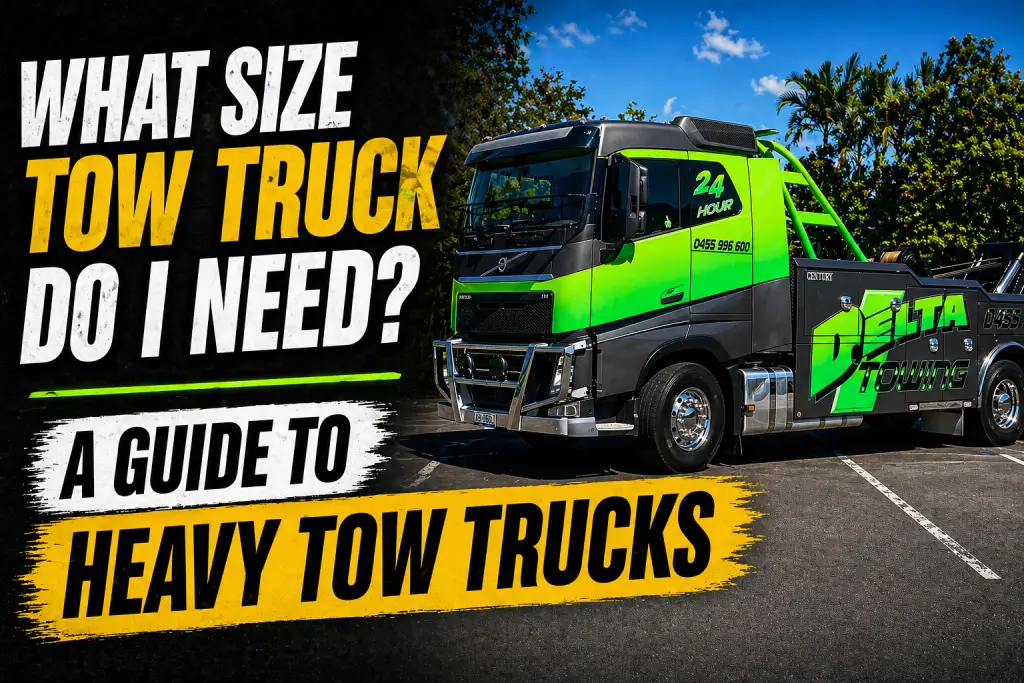
What Size Tow Truck Do I Need?
Tow trucks come in different sizes for the same reason hammers come in different sizes. Using a sledgehammer to hang a picture frame is overkill. Using a tack hammer to drive a fencing post is dangerous. The principle applies directly to towing: the tow truck needs to match the vehicle being towed, and getting it wrong creates problems.
When you call for a tow, the dispatcher should be asking you questions that help them select the right truck. But it helps to understand the categories so you know what to expect.
Light Duty Tow Trucks
What they handle: Passenger cars, utes, vans, motorcycles, small trailers, and light commercial vehicles up to about 4.5 tonnes GVM.
What they look like: Flatbed tilt trays, wheel-lift trucks, and car carriers. The truck itself is typically a medium rigid or large ute with a tray on the back. Total capacity is usually 3-5 tonnes.
Common situations: Car breakdowns, accident towing for cars, dealership deliveries, and roadside assist callouts. These are the trucks you see most often on Brisbane's roads because car breakdowns outnumber truck breakdowns by a large margin.
Medium Duty Tow Trucks
What they handle: Larger vans, small trucks, delivery vehicles, horse floats, caravans, and commercial vehicles roughly in the 4.5-11 tonne range.
What they look like: Larger tilt trays on a rigid truck chassis. These trucks have more powerful winches and higher-rated trays than light duty trucks but are still smaller and more manoeuvrable than full heavy-duty units.
Common situations: Delivery truck breakdowns, small bus towing, equipment transport within weight range, and commercial vehicle relocations.
Heavy Duty Tow Trucks
What they handle: Semi-trailers, B-doubles, rigid trucks above 11 tonnes, city buses, coaches, earthmoving equipment, and industrial machinery. Anything too heavy for medium duty equipment.
What they look like: Large prime-mover-based boom trucks with hydraulic underlift systems, heavy tilt trays rated to 20-25 tonnes on multi-axle trailers, and low loaders with ramp access for tracked machinery.
Common situations: Truck breakdowns on highways, accident recovery for heavy vehicles, bus towing, machinery transport to construction sites, and heavy vehicle recovery operations including rollovers and off-road extractions.
Super Heavy and Specialist Equipment
What they handle: Extreme loads, complex recoveries, and situations where standard heavy duty equipment is not enough. Road trains, very heavy individual items, and multi-vehicle recovery scenes.
What they look like: Rotator recovery units (a crane-like arm mounted on a heavy truck chassis that can lift, rotate, and reposition vehicles), heavy-lift cranes, and multi-truck recovery rigs.
Common situations: Rolled semi-trailers, jack-knifed B-doubles, embankment recoveries where the vehicle needs to be lifted and repositioned, and any situation where a standard tow truck cannot safely reach or lift the casualty vehicle.
How to Tell the Dispatcher What You Need
You do not need to know tow truck categories to get the right truck sent to you. Just tell the dispatcher:
What you are driving (make, model, configuration). Your best guess at the weight (loaded or unloaded). What went wrong (engine failure, flat tyre, accident, bogged). Your location (GPS pin, street address, or nearest landmark). Where you want the vehicle taken.
A good dispatcher will match the right truck to the job based on this information. If they do not ask these questions, that is a warning sign, because sending the wrong truck wastes everyone's time.
Why It Matters
Sending a truck that is too small means it arrives, cannot do the job, and has to call for backup. You wait longer, the road is blocked longer, and you may end up paying for two callouts.
Sending a truck that is too large is less common but can happen with companies that only have one size of truck. You end up paying for a 25-tonne tilt tray to move a 5-tonne truck. Some operators charge the same regardless of truck size. Others charge more for larger equipment.
The best outcome is the right truck arriving the first time, ready to do the job. That requires a dispatcher who asks the right questions and a fleet with enough variety to match the job.
For heavy tow trucks in Brisbane, call Delta Heavy Towing on 0455 996 600.
Need this handled today?
Dispatch is staffed 24 hours a day, and we quote before the truck rolls. Tell us the vehicle, the location and where it needs to go.
Keep reading
Related guides
Heavy Towing Near Me: How to Find Reliable Heavy Towing in Brisbane
When you search "heavy towing near me" on your phone while standing next to a dead truck on the side of the road, you are not in the mood for researc…
Read the article
Truck Towing 101: Everything Fleet Managers Need to Know
If you manage a fleet of truck towing is not something you plan for. It is something that happens when plans fail. An engine lets go on the M1. A dri…
Read the article
When to Call a Heavy Vehicle Towing Service (And What to Expect)
Not every truck problem needs a tow. Sometimes a mobile mechanic can fix it on the side of the road. Sometimes the driver can limp it to the next exi…
Read the article