
Towing a Lorry in Australia: Rules, Requirements and Process
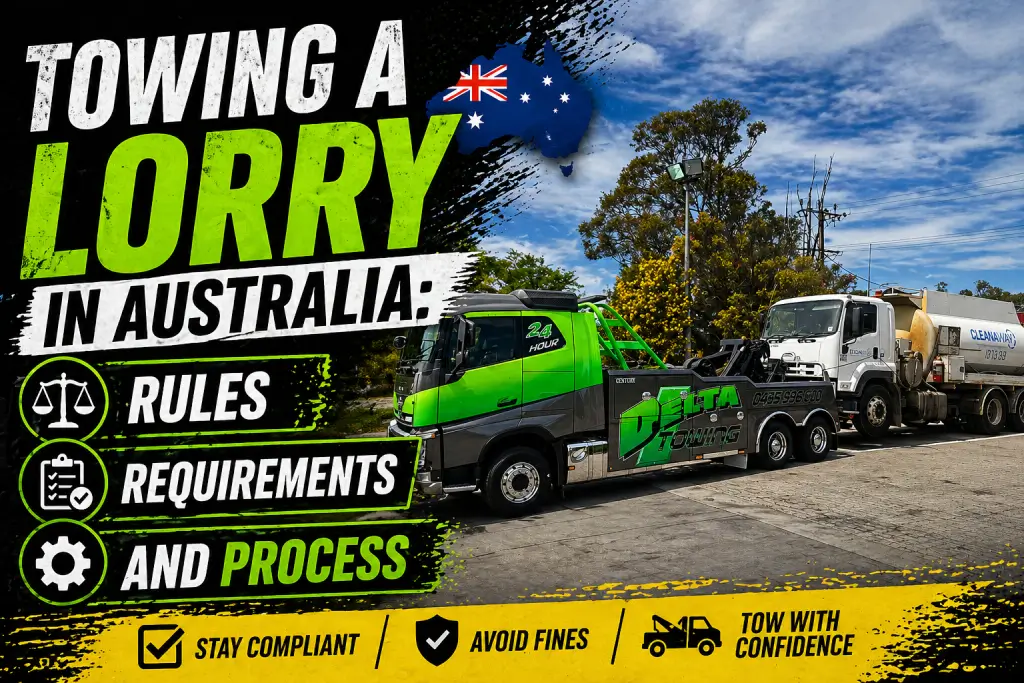
In Australia, we tend to say "truck" rather than "lorry," but the search traffic tells us plenty of people use the word lorry when looking for heavy vehicle towing information. This article covers the rules and process for towing heavy commercial vehicles on Australian roads, regardless of what you call them.
Who Can Tow a Heavy Vehicle
In Australia, the tow truck operator must hold a licence class appropriate for the tow truck they are driving. A heavy tow truck typically requires a Heavy Rigid (HR) or Heavy Combination (HC) licence. Multi-Combination (MC) licences are needed for tow trucks pulling trailers or operating as part of a multi-vehicle combination.
In Queensland, tow truck operators must also comply with the Tow Truck Act 1973, which regulates licensing and conduct of tow truck services. The operator needs to be either a licensed tow truck driver or employed by a licensed tow truck business.
Rules for Towing Heavy Vehicles on Roads
When a heavy vehicle is being towed, it must display appropriate lighting. If the casualty vehicle's lights are not working, the tow truck operator needs to ensure the combination is visible to other road users, particularly at night or in low-visibility conditions.
Towed vehicles must comply with mass limits. The combined weight of the tow truck and the casualty vehicle must not exceed the tow truck's rated capacity. Overloading a tow truck creates braking and stability issues.
Speed restrictions may apply. In Queensland, a vehicle being towed should not exceed 80 km/h unless it is being carried on a tilt tray or low loader where normal speed limits apply.
Chain of Responsibility (CoR) laws apply to towing operations. The towing company shares responsibility for ensuring the vehicle being towed is transported safely. This includes proper load restraint if the vehicle is loaded, appropriate mass management, and fatigue management for the tow truck driver.
The Towing Process
The process starts with a phone call. The vehicle owner or driver contacts a towing company and provides the vehicle details, location, and destination. The towing company dispatches an appropriate tow truck.
On arrival, the operator inspects the casualty vehicle to determine the best towing method. For trucks with working steering and brakes, a boom truck connection works well: the tow truck lifts one end of the truck and tows it on its remaining wheels. For trucks without working steering, brakes, or driveline, loading onto a tilt tray or performing a driveline disconnect is necessary.
The operator presents an Authority to Tow form. This document confirms the vehicle owner's consent for the tow and specifies the destination. Review it before signing.
The tow is then completed and the vehicle delivered to the nominated destination. An invoice is provided, which should match any quote given before dispatch.
Common Mistakes
Calling a car towing company for a lorry or truck. Car tow trucks are not rated for heavy vehicles. Even if the operator is willing to try, the equipment is not designed for the weight and the insurance may not cover it.
Not knowing the vehicle weight. The tow truck needs to be rated for the casualty vehicle's weight. If you do not know the GVM of your truck, check the compliance plate on the vehicle or provide the make and model to the dispatcher.
Driving a truck that should be towed. If there is any doubt about whether the vehicle is safe to drive, tow it. The cost of a tow is always less than the cost of an accident caused by a mechanical failure.
For truck and lorry towing in Brisbane, call Delta Heavy Towing on 0455 996 600.
Need this handled today?
Dispatch is staffed 24 hours a day, and we quote before the truck rolls. Tell us the vehicle, the location and where it needs to go.
Keep reading
Related guides
Emergency Heavy Towing: What Happens When Your Truck Breaks Down at 2AM
Emergency heavy towing is what stands between a stranded driver and a resolved crisis. The phone rings at 2am. It's your driver. The truck has stoppe…
Read the article
When a Bus Breaks Down: What Operators Should Do Next
Imagine a busy highway getting obstructed by a stranded bus that's stuck during peak hour. You can understand how the stressful situation might be! T…
Read the article
How Delta Heavy Towing Ensures Quick and Safe Truck Recovery Across Queensland
Have you ever faced a truck breakdown on the road? If yes, you better know how important it is having a responsible hand to professionally deal with …
Read the article